Day 24 – The desire within beauty has always intrigued me. The heart of the idea, as I put it in an essay, that “to want is really to want more of something” is hard to pinpoint.
I’ve been slowing reading Karl Ove Knausgard’s My Struggle. Since I’m behind everyone else who have likely read up to the 6th book, I’m just now reckoning with his famous descriptions of minutiae. One such philosophical maundering struck me. He talks about the feeling he gets when looking at particular paintings. He says:
…the feelings the pictures evoked in me went against everything I had learned about what art was and what it was for…even though the pictures were supposed to be idylls, such as Claude’s archaic landscapes, I was always unsettled when I left them because what they possessed, the core of their being, was inexhaustibility and what that wrought in me was a kind of desire.
…The pictures made my insides tremble, but for what? The picture filled me with longing, but for what?
…But the moment I focused my gaze on the paining again all of my reasoning vanished in the surge of energy and beauty that arose in me. Yes, yes, yes, I heard. That’s where it is. That’s where I have to go. But what was it I had said yes to? Where was it I had to go?
Have you felt this too? The longing that is in something fantastic. I think this is the thing that also makes certain books impossible to put down, how we say that we’ve “devoured” it. It is something from the idyllic that is not fulfilled by its idyllic representation, but spurred by it.
I was driving up to Sacramento to meet my best friend’s baby when I heard a song lyric that seemed to respond to this question. From Bill Callahan’s song Winter Road, he says:
The blinding lights of the kingdom can make you weep
I have learned
When things are beautiful
To just keep on
Just keep on
Often, it is when things are dark and impossible we tell ourselves to just keep on. I meditated on the idea for a long time.
When things are beautiful, when the beauty is staggering, it can be paralyzing. The mind wants to understand what the body is experiencing. Reasoning gets in the way and we find ourselves further from it.
Do we want it? Do want to be it? Or, might it serve as is a reminder of what possibility means. Possibility is neither having nor becoming the thing we desire, but to hold the thing within us.
I’ve talked about my morning meditations before, those dedicated to manifesting. The point of these is to hold the idea of what I want as a vision, not one that I see coming true, but as one already part of my being.
Day 23 – I’ve been waiting for months to hear back from a very excellent magazine about an essay I sent them. I had submitted once before, about a year and a half ago, and got a slip of paper in the mail 9 months later telling me thank you, but that they were going to pass.
This time, when the email popped up, I held my breath. I’d submitted one of my favorite essays, the first one that finally clicked. I feel like a pretty accomplished poet, but the non-fiction thing is something I’ve had to teach myself how to do. And it’s taken a long time.
I’d struggled to write this particular essay for months, so long that I began to doubt whether it would ever be good. It went through 15 drafts. Then, the thing that I hope for, when all of the seemingly disparate elements come together informing the theme of the essay AND when the story itself finds its most clear, distinct shape, happens and I am the happiest woman alive. The funny thing is that I forget that I can get there. Something keeps me writing, though, and revising and brooding on why I’ve brought these ideas and people and events together in the first place. Every time I don’t think the essay will make it. But it always does, in the end.
Here’s the response I got from the magazine:
Dear Sophie,
Thanks for sending us “Wife to Myself.” We really liked this piece; I’m genuinely sorry to say that in the end we decided its not quite right [for us]…
We found the writing in your essay lovely – for example, when you talk about imagining the domestic dinner scenes behind softly lit windows: “I felt my own presence vulgar, dreaming myself into their windows, longing to be invited in.” And we were intrigued by the underlying themes of the essay: wanting your own family from a young age, the aversion to twilight, your transformation from a slovenly roommate to someone who pays attention to domestic matters.
But several readers read this, and we all felt that there was a missing piece here: we wanted to know more about the unravelling of your marriage…
The editor goes on to suggest that maybe I was reluctant to include such personal information. Her feedback is of immeasurable value to me. In fact, I didn’t even know this lapse in the story existed. Now that I do, I can respond to it.
The editor’s personal response made me almost as happy as if the piece had been accepted. I know the essay is good and that the editor had enough faith in my writing to help me see what’s missing, heartens me.
In her closing comments, she said that they really liked my writing and hoped I would submit other essays. I am grateful for this reminder to go forward when it is hard, when I think an essay sucks and will never get better, and when I think it is good, but can improve it still.
Day 22 – In one of the Magic Lesson’s podcasts, Elizabeth Gilbert has a conversation with a woman who wants to tell a story, through photos paired with text, about her brother. The woman has been taking photos of her brother for a while, documenting his struggle with PTSD and drug addiction. The bigger project of organizing the raw materials daunts her. She can’t get started.
There is a moment when Gilbert asks her why she started this project, how has it changed her life.
The woman takes a minute to compose herself and, in a deeper tone of equal amounts shame and relief, she says, “it helped me stop judging him.”
I had paused the podcast for a minute. The question prompted me to consider this about my own creative project, a collection of stories/personal essays. More than two years ago I started writing them, but over that time, they’ve changed. Their texture is different. Earlier ones don’t have the empathy and strength of voice more recent ones do.Of course, the more I write, the writing itself improves, but there is something else at work. Every new day informs the past. Until recently, I didn’t quite understand what they meant.
Their function has changed. I want to see something within my experience that will serve others, the way others do for me. When I decided to move, it was so clear that the stuckness my essays were effected by, my inability or the slow-going it took to get them up the hill to their peak, is because the were being written from a place in the past. Literally, I was writing them in the office that had been by husband’s. My story had come full circle, but not transcendent. In other words, in order for my stories to have that kind of movement, my own story needed to actually move.
In the interview Hemingway gave the Paris Review (Spring, 1958 issue), I think he puts it best:
INTERVIEWER
Finally, a fundamental question: as a creative writer what do you think is the function of your art? Why a representation of fact, rather than fact itself?
HEMINGWAY
Why be puzzled by that? From things that have happened and from things as they exist and from all things that you know and all those you cannot know, you make something through your invention that is not a representation but a whole new thing truer than anything true and alive, and you make it alive, and if you make it well enough, you give it immortality. That is why you write and for no other reason that you know of. But what about all the reasons that no one knows?
Also, this, my essays did begin to be true until I stopped judging the events and the self (the various iterations of the selves I’ve been) that appeared in them. It cannot be “truer than anything true and alive” if you wish it dead, if you wish parts of yourself were not what they are.
Day 21 – And…I’m nervous. As my adventure date approaches, the glow is wearing off and reality is setting in. I have to remember that I want to get out of my comfort zone. I’m choosing that. Traveling alone, not speaking the language, not having many friends there, blah blah blah.
OK, this is my one little life. I wanna live.
Also, there was a new moon last night. Earlier in the week, I had decided I’d set some intentions for myself on this occasion, but instead I set reverse intentions. Sometimes we cling to old, familiar comforts when faced with the challenge to make a leap, then you realize that those old comforts no longer serve you.
Erika reminded me that we’re still in the energy of the new moon, so with my mistake-laden reverse intentions in mind, I’m going to make some new ones!
From the Collective Evolution website I learned that we also had a solar eclipse in Virgo last night. It explains:
This type of eclipse (annular) is commonly referred to as a ‘Ring of Fire’ because when it is in its totality, the Sun’s light forms the lit up edges, appearing as a ring…
Solar Eclipses are very potent New Moons that generally happen every 6 months. Astrologically this is recognized as a time of powerful changes and new beginnings in specific area(s) of our lives. These changes build up in the 6 weeks before and play out during the following 4-6 month period leading up to the next one. However, this upcoming month is when we will see most of the shifts taking place.
We are encouraged to consider what Virgo-themed changes have been happening in our lives:
How can you make your life more efficient and productive and what is preventing that? What are your counterproductive patterns (and/or habits) and how can you rearrange your lifestyle in order to transcend them? What do you need to do to improve your health and overall well-being? Some people have been experiencing health complications, which is the body trying to get your attention to make positive changes. Pay attention to any signs like that. (http://www.collective-evolution.com/2016/08/31/ring-of-fire-solar-eclipse-in-virgo-this-is-whats-going-on/)
Day 20 – The other day, my instructor opened our yoga class by talking about the idea of abhyasa. She described it as the daily, nitty-gritty work we put in to achieving our grander goals.
In my morning meditations I often focus on what I want to manifest in my life. The idea is that we create this image, send it out into the universe, then let go of it, understanding that it is in the hands of a greater wisdom. It requires the belief that it will be taken care of paired with the work of going about your daily business to get you there. It sounds contradictory at first, but the heart of it is total trust, both in yourself and in the higher , timeless wisdom.
Yoga Journal explains the idea of abhyasa and the idea of “Balancing Effort and Surrender“:
The word abhyasa is rooted in, as meaning “to sit.” But abhyasa isn’t your garden-variety sitting. Rather, abhyasa implies action without interruptionaction that’s not easily distracted, discouraged, or bored. Abhyasa builds on itself, just as a ball rolling downhill picks up momentum; the more we practice, the more we want to practice, and the faster we reach our destination.
As also means “to be present.” This reminds us that for our practice to be effective, we must always be intensely present to what we’re doing. Eventually, such resolute, vigilant enterprise on the yoga mat becomes part and parcel of everything we do in daily life. (http://www.yogajournal.com/article/philosophy/balancing-effort-and-surrender/)
I’m so grateful to my instructor for sharing this idea with us!
Day 19 – I’d been thinking about moving for a some time. While hanging out one night with friends, two of which were visiting from another country, and in seeing how much fun the foreign friends were having here, I got serious about my adventure fantasizing.
Then, there was a message.
I noticed that a writer I’d met briefly was posting a lot of pictures of himself in Budapest, so I wrote him and asked if he was doing a residency there. This was his story.
He said that he didn’t like the company he was working for, and he didn’t like where they had him living, so he decided to quit that job. He bought a oneway ticket for Budapest, rented an apartment and was working on writing his second novel there until the spring when he would come back to the states and decide what to do with his life. Fuck, I thought, I love that story.
A few days later, I’d booked my flight, found an apartment in Berlin, had someone to sublet my apartment while I was away, and lined up the next few classes teaching online (to secure my funds). It was all so easy. The little ropes tying me to this life were so easy to snap, one by one, like in Gulliver’s Travels, as one friend put it.
Day 18 – I started thinking seriously about how happiness could be cultivated. I’d picked up the book, The Happiness Project, at the airport several months ago and started reading it, but then stopped. It was very good and practical, but, something about it overwhelmed me. After I read Grit, I realized what it was. For so long, I didn’t know what I really wanted out of life and from myself. That had to be the first question I asked myself.
Actually, the reason I read Grit, the desire that allowed the recommendation from a friend to manifest in my life, happened a month earlier at a dinner with my friend Ashley.
She’d come out of a divorce and had to ask herself what she wanted. She’d been unhappy without knowing it for years. To fix that feeling she clung to the thing she knew and got married ,even though she and her partner had never cared before about getting married before. Well, it all fell apart, of course, and she started doing some self work. She said she’d always known what she wanted but thought it was weird. “I want to live with my dog in my own house and have an amazing career.” After her divorce, she found the job she wanted, moved into her own house, funded by the money she was making with her new career, and now lives there with her dog, loving her life.
What do I want, I had asked myself after our dinner date? I meditated on this question extensively. I want to write. I don’t want to write copy for products or work in marketing, but I want instead to tell my own stories.
I’ve been doing that, so why isn’t it moving me forward?
I think there were many reasons, but namely, I didn’t have faith in even making that the primary goal. I had to say it aloud and believe in it myself. Then, I had to do it.
The next question was, why aren’t I writing more? This answer was easy. I work from home (teaching online) and write from home too. Though I have an active social life, I see friends constantly, I go to coffeeshops to work, I go to yoga classes, I get out, etc., I still spend the majority of my life in my house, the house I moved into with my then finance and the expectation of a very different life.
If the stories I’m telling were going to serve anyone other than myself, they had to come to a place of having moved forward, of having learned something true and useful. You don’t tell a story that has no point. You tell a story when you’ve figured out the meaning or lesson from your experience and you think it would serve someone else to hear. It is not that my stories were sad or lacked epiphany or insight, but that they were born, literally, in a place seeded in the past.
How far could I get with this tether to my old life? That made it very easy to snap the ties I felt to the comforts of my house, my life, my stable predictable day-to-day.
After it occurred to me that I am doing what I want to (writing) and I know what my passion is, the next goal is to do it better. And, do it bigger.
What I found interesting about Grit is that one of the precepts it promotes is one found in all spiritual guidance for living with purpose and mindfulness. It mandates that one engage in work they not only enjoy, but that serves others. My stories could not fully help someone else until they were fully helping me, and vice versa. We (me and the writing) both had to grow and expand and open to every possibility.
What does this look like? Full trust in my ability to write a good story.
And I do, time and time again. It amazes me with each instance that this happens, but it does happen, with hours of work (and sometimes years of working on just one essay.) Something clicks and the story transcends itself and what I thought it could be. I jokingly say, “it was written by divine inspiration.” But it’s not a joke. I work and work and work, but then something else comes through, I tap into it and it comes through me. That is the part that is beyond my ego and makes my representation of life useful to someone else. So I trust myself to put in the labor and the universe to support me.
What else does it look like? Getting out of my comfort zone. Moving to a country where I don’t speak the language or that I’ve ever even visited. Jar my senses. This is the cure to fear. When you are afraid to do something, it shakes you wide awake and afterward, you’re a million times be content and confident from having done it.
My dad has said, “get up and make your life happen”
My mom says, “go out and make your life shine”
Both begin with the impulse toward movement. When I heard these words of advice, though, I got caught up in the how. How the hell do I make my life shine? I work and try, but nothing is happening. What do I do? I sit still and listen.
This is my one life little life. I say, fuck it to fear. Where are the crystals I energized at the sound bath last night?
Does this make me sound crazy and new age? Yes, but saying fuck it to embarrassment too, is another tenet to being open. As long as what I’m putting out there, what I’m sharing with the world, comes from a place of loving kindness and my authentic desire to do good, and with integrity, I give zero shits about looking silly.
Only if it is a hurtful, negative thought do I think twice about putting it out there.
Tis is the life I’ve chosen to live, so I can live it better, do it so it suits me. I am naturally curious. I want to be startled every day. I can stand at the precipice or I can just jump.
My dad also once shared with me the piece of career advice his own father gave him. Just pick something and stick with it. While the choice of what you pick shouldn’t be totally arbitrary, as Duckworth says in Grit, it should be something you like and have a natural interest in, the sticking with it is key.
Just the act of throwing yourself into something, of basing the majority of your decisions — those grand plans as well as the day-to-day to day tasks –around accomplishing that thing you believe in, is rewarding in itself. Laboring at something you truly dedicate your time and energy and heart to, generates its own kind of love.
Day 17 – I was reading about mindfulness from Gretchen Rubin’s book, The Happiness Project, this morning. In this book she posits the question, “What do I want from life , anyway?”
In the aforementioned chapter, Rubin talks about finding the idea of meditating unbearable, but still wanting to cultivate “conscious, non-judgmental awareness.” As I read this, I looked down at my cat who was curled in my lap, looking up at me.
Oh yeah, I thought, this is exactly where I want to be right now, so I should take full advantage of being here. This moment is perfect.
During my morning creativity rituals, which entails reading something that inspires me, I tend to get filled with ideas. My mind files these ideas into different essay threads or ways to integrate new, beneficial practices into my life. It gets me excited and my intellectual juices flowing. As Rubin reminds us throughout her project, curiosity invigorates.
I looked down at my cat and thought, in a couple weeks I’ll be in Germany and I won’t get to do this. One day, she’ll won’t be in my life at all. But, more importantly and much more positively (and gratefully), she is here now and I am very happy about that. I told her so.
I turned a few pages in the book and read the line, “Instead of walking though life on auto-pilot, I wanted to question the assumptions I made without noticing.”
I’ve been thinking the key to saying YES is to reject the impulse to hold beliefs based on principle. To open yourself up, you have to move from the assumption of NO to YES.
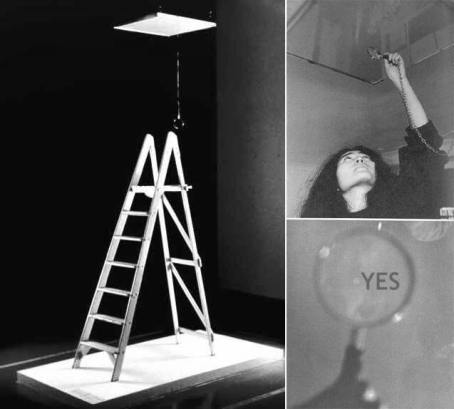
Yoko Ono’s famous Yes! art instillation came to mind —more so, John Lennon’s reaction to it. I’d heard him talk about it once, the now infamous Ono exhibit where the two met, and how things could have gone very differently between them.
I googled it. In an interview Lennon describes the exhibit, how you had to climb a ladder, then hold a magnifying class up to the ceiling to read what was printed there. Here he is talking about it:
“You’re on this ladder — you feel like a fool, you could fall any minute — and you look through it and it just says ‘YES’ …Well, all the so-called avant-garde art at the time, and everything that was supposedly interesting, was all negative; this smash-the-piano-with-a-hammer, break-the-sculpture, boring, negative crap. It was all anti-, anti-, anti-. Anti-art, anti-establishment. And just that ‘YES’ made me stay in a gallery full of apples and nails, instead of just walking out saying, ‘I’m not gonna buy any of this crap.’” (http://entertainment.howstuffworks.com/john-lennon30.htm)
If it had said, “NO,” I imagine he would have walked out the door and never looked back. But it didn’t say no, and he didn’t leave, and we all know how the rest of the story goes.
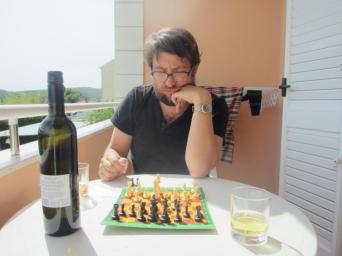
(the one and only time I beat Frank at chess, which happened to be in Croatia)
Day 16 – I heard an author talking about how all we have is the present moment because seeking more than that, seeking some kind of certainty, well, certainty doesn’t exist.
A friend asked if I was meeting up with anyone in Berlin. While I have a friend or two, I mostly know no one. It scared me for a second, to realize this, until I remembered that that is exactly why I’m going there. Nothing like making new friends!
I remember once, on a rainy night in Dubrovnik, Frank and I made our way to a local bar filled with young Croatians. Frank liked to play chess, so we brought our portable chessboard with us everywhere. In the bar, people crowded around looking at the board, then telling Frank or I what move to make next. I was no real match for Frank, a man who spends much of his free time playing chess online with masters, so after he beat me, a local challenged him to the next game. His English was surprising good.
The young people there speak it, unlike many middle aged Croatian folks we met who speak some German, French or Italian, but little English.
What sticks out to me was how nice it was to speak English and to share the customs of booze and bar activities. To converse freely, with someone other than Frank, since he had been the only person I spent time with during our travels who shared the same language, was an unexpected delight.
We had a raucous drunken night, stumbling home later by way of a flooded upward stairway along a narrow Dubrovnik alley that had become a small river. It was one of the best nights. To be folded into a tiny corner of a culture so different from ours, but at the same time, no different at all because we are all people and happy there together.
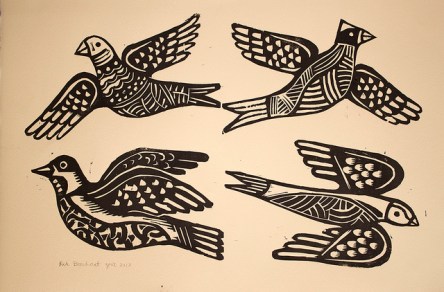
(from a broadside I made in 2010 at Mills College)
Day 15 – In the early stages of an essay, I wrote the line, “I need the space to think differently.” Though it went through many drafts and revisions, that sentence stuck. The word “space” here works in two ways: 1) as in enough room, and (2) as in place, a new purposeful location.
The essay was titled, “Missing Person” or, sometimes, “I Go Missing.”
It was not about leaving, actually. Regrettably, it was not about making the decision to create a space or place where I could think differently, but about many failed attempts to do so, without really knowing what I was trying to do. I see, in retrospect, it was about wanting to change and move forward, but not knowing how or who I wanted to be.
Now, I understand that, if you try to leave without grounding yourself first, your spirit escapes and you go missing from yourself like smoke from the tip of a cigarette.
It can be hard, sometimes, to remember who you are. What makes you happy, what you love, who loves you, what you’re supposed to do. Giving works. Giving to others helps you let yourself back in. Maybe because in recognizing that others are forgivable animals, recognizing how much you love them, you can love it about yourself too.
In that vein, I like to re-read these opening verses in A Song for Occupations, from Whitman’s Leaves of Grass:
Come closer to me, Push close my lovers and take the best I possess, Yield closer and closer and give me the best you possess.
(Leonard Cohen does a headstand on the side of the road while waiting for the broken-down tour bus (1974). Photo by Emily Bindiger)
Day 14 – In yoga today, the teacher said something that caused me to pause, “When you practice yoga it is for an audience of one. No one but you is watching to see if you push yourself or if you give yourself a break to rest. You decide what your body needs and give yourself that.”
I realized that in yoga, I often take the more challenging variation of a pose, even when I know I probably can’t do it. I also rest when I need to. Until she said this, however, I never actually noticed that I do this, probably, because I consider myself a vehemently non-competitive person. Nor am I an athlete. So opposed to sports participation and being forced into competition with my peers, that even in elementary I protested. If the volleyball or softball made it to me way out in left field, I’d raise my arm without even a feigned attempt at catching it or caring.
This was not considerate to my teammates, however.
Whatever it was about sports teams that caused me to reject them, probably my lack of confidence in my athletic ability paired with the fear of being hit with a ball, despite the fact boys constantly yelled out to me, “the balls not gonna bite you,” I understood that I liked doing physical things that I had total control over.
So, I practiced ballet. Sometimes, even today, when I have anxiety and want to still my mind or I can’t fall asleep at night, I envision myself doing barre exercises. I can them in my bones. They’re rigid movements and the routine brought be great pleasure.
In both ballet and yoga, the control I speak of, is more the idea of mastery. My body actually responds very quickly to these practices. I can see my muscles grow defined after just a few days. Pushing myself gives me a very visual reward that can’t get lost in my thoughts.
I couldn’t do a headstand yesterday, but today I can. I couldn’t do the splits yesterday, but today I can.
Because I’m not competitive with others, I’ve mistakenly thought that I’m not driven in all areas of my life. The teacher’s comment reminded me that I am dedicated, motivated, and self-confident.
I love strenuous movement that I can practice alone. Like writing. Like travel. It’s all kinda the same thing.
Day 13 – Something I heard on a episode of Elizabeth Gilbert’s podcast “Magic Lessons” caused me to examine the impetus of my desire to move.
In the episode, “Turn the brutal into the beautiful” Gilbert has a conversation with photographer Brandon Stanton (creator of the gorgeous and brilliant Humans of New York project. He explains the idea of courage, how courage is not something that happens by waiting around for it, but that you get it by doing what you are afraid of doing while you’re afraid of it. The latter is the important part, I think.
He goes on to say that “time is the most important commodity we have.” It made me of consider all the time I’ve spent trying to hold onto something I don’t really want. Stanton shares the story of how he went from a bonds trader to an artist. He’d always considered himself a creative person, then this prestigious job trading bonds fell into his lap. He told himself that he’d make his money, then carve out a space to make art. Two years later he lost the bonds trading job and realized he had spent 2 years of his life putting all his brain power into how to hold on to this job that wasn’t even what he wanted to be doing in the first place.
His solution was to make just enough money so that he could be in control of his time (or most of his time at least).
* * *
A few people have asked me why Berlin. I don’t speak German and it’s kind of a lousy time of year to go weather-wise, especially since I was dreaming of European swimming holes and crystalline waters lapping pebbled beaches. I dreamed it all through the smoky, firestorm this summer in LA has been.
Also, I did I mention that I’ve never been to Berlin? Nowhere in Germany, actually.
I found myself saying, “I can stay in Berlin or I’ll travel around. I’m open. Italy this summer sounds nice. But, I could just as easily go Budapest.”
The day I decided to move came after the most bizarre 36 hours, which began when I spent an impetuous and impassioned night with my new foreign lover who was returning to his homeland in less than a week. After a dreamy, soft morning with him in my white blanketed bed, drinking coffee from white coffee mugs, I got a call from my mom saying that an elder family member was put in hospice care and I needed to come immediately.
My brother and sister left work mid-day and together we drove to Newport Beach to see her. When we left the hospital, we breathed the air of the living and were grateful, so we went to the beach. We swam past the waves and I submerged my body and head in ocean, opening my eyes underwater, and floating onto my back so my toes pointed skyward. I felt part of the sea and everything else.
That evening, I got drunk accidentally at a Mexican food restaurant with my family, then fell sleep in the backseat of my sister’s car for a surreal drive back to LA with my brother at the wheel guiding us home. I woke up the next morning and thought, shit, I have to check email and see if I got that Dr. Phil job. That’s right, The Dr. Phil, but don’t get it excited, it was only a copy writing job for the website.
As I opened my computer, I got a sinking feeling that I didn’t want the job, actually. I told myself that if I got it, I’d take it because I want to be open to all possibilites and I need $$$. This would mean, however, that I’d keep living the same life I lived now, but 8 hours of my day would belong to the Dr. Phil.
I also told myself that if I didn’t get the job, I was moving to Berlin. No doubt about it. If I got scared or it felt difficult, I would power through. This was my promise.
I didn’t get the job. My ego felt a little pang of hurt, but it was followed by immense relief. And, of course it was a sign.
Like selling my ring. Doing something scary, but meaningful and deliberate, is LIBERATING. Deciding to leave my home has galvanized every part of my life.
Stanton prefaces his idea of courage begetting courage with the notion that becoming adept and accomplished at something happens the exact same way.
Practice and diligence is echoed all throughout the book Grit, too. Stanton’s advice really nails the point though: You become an expert by doing the thing, not by waiting for knowledge to impart itself on you.
I guess this is all to say that I see courage and expertise as inherently linked, both needed for taking that leap!
Day 12 – It is no accident I had these insecurities during the full moon. Sorry, not sorry, for being witchy and new age and out there.
I googled the full moon and learned this:
“In fact during full moon, everything will be magnified, good and bad. Therefore full moon can be both viewed as a time of crisis as well as a time of opportunity. It depends on our overall state and activity during the full moon day to cultivate its positive or negative effects.” (A Time of Opportunity, pranaworld.net)
Here’s an example. I felt like crying. It was interrupting my attempt to meditate. I thought, should I call my mom and cry on the phone and complain and wallow? That would feel good. And there is a time and place for catharsis, certainly, but then I thought, then I’ll be immersed in that feeling and I don’t actually want to be. I want to acknowledge it and then find a way out from the inside of it.
Hoping for what you want and getting it are like the planets lining up. It happens only for one brief second before what you wanted and what really is, slip past each other. The act also reminds me of a kiss. It cannot last forever and the next moment will be entirely its own unpredictable thing.
From space.com’s 2 minute video about August’s full moon, I learned, “There is only one infinitely short instant when the moon is truly full.”
Day 11 – I paced my apartment this morning, overwhelmed, frantic. Had I not spent all day yesterday thinking about hope? This morning, I woke up, and one little sign banished it. Not even a sign, an absence of one. I attempted to get back into that place of openness. I reminded myself of a song lyric I heard that two days ago, “Everything will be alright if you just let go,” how I had repeated that line over and over to myself through a panic attack, until my heartbeat returned to normal and the lyric was integrated into my being.
But as I paced between my office to the kitchen this morning, searching for the inspiration or impetus to write, I noticed the blue spine of a book on my shelf. Knowing, if I should do anything at all, it is to follow signs, I came back and looked at what it is, Joan Didion’s Slouching Toward Bethlehem. I told myself I would read any essay I happened to flip open to. I landed on the essay titled, On Self-Respect.
Didion talks about what I’ve been thinking of as dynamic/ generative hope, but what she calls “self-respect:”
“Self-respect is something that our grandparents, whether or not they had it, knew all about. They had instilled in them, young, a certain discipline, the sense that one lives by doing things that one does not particularly want to do, by putting fears and doubts to one side, by weighing immediate comforts against the possibility of larger, even intangible, comforts.”
Maybe this is the combination of grit and hope.
It is a reminder of the idea that we work hard, believe in ourselves as natural functions of the universe, let go of reputation, and trust that we will blossom into not what we can imagine for ourselves, but into the possibilities we cannot fathom.
This trust is, as Didion puts it:
“To have the sense of one’s intrinsic worth which constitutes self-respect is potentially to have everything: the ability to discriminate, to love and to remain indifferent. To lack it is to be locked within oneself, paradoxically incapable of either love or indifference.”
So much of what defines us comes from doing what is hard. These challenges also are what leads to happiness. We are not trapped with in the whims of the day to day traumas, or what I talk about in one of my essays , “The Way Back to My Body,” when you feel cut off from life, “when you are alone in yourself, as if there is no universe to feel apart of, only stuck in a body abused by chaos or rapture.” We can transcend them.
In Grit, Duckworth talks about how feelings of hopelessness are tied to a perceived lack of control over your life. While you can’t control all circumstances, you can control your reaction to them and you can control what you choose to hold on to versus what you choose to let go of. Listening to yourself, trusting that wisdom, means when to say yes and when to say no.
It is easy to stress and fret and hard to let go. But you can practice at it and improve, then you see how much easier releasing hang-ups and worries is.
One of my favorite practices, which I learned from Manifest Your Destiny by Wayne Dyer goes, “With every breath you take, feel yourself taking in unconditional love. With every exhalation, expel thoughts of fear.” Centering yourself and detaching from attempts to control is liberating.
Balance means accepting the good with the bad and taking it all in stride and without paralyzing fear. It is here now, it will also pass.
These past few days I’ve been feeling really open, like too open almost, everything is rushing in. I can barely keep up. Like my entire periphery has decided to join the foreground.
It reminds me of when you stay up all night to the morning with your lover or remaining party stragglers and you’re exhausted, but revved. Then you have to go out and order a huge stack of pancakes to bring you back down to earth.
Day 9 – This morning my dog woke me to walk him while it was still dark and I was groggy, wanting to stay in bed longer.
He pulled me down the sidewalk. I was still rubbing my eyes, when I saw a woman approaching. I managed a sleepy smile to which she responded with a robust “Good morning!” and a giant, loving grin. That was nice, I thought.
As I kept walking, the next person I encountered said the same thing, not with quite the vigor of the first, but very friendly. As it kept happening, I looked down at my little dog to see if there was something cuter about him today than other days, something to elicit such open friendliness from each passing stranger on a Tuesday morning. Cute little dogs tend to soften people, naturally, but this was something more. By the time I got home, I was brimming with joy and shinning my own a huge grin for anyone I walked by.
Truly, your mornings shapes the rest of the day. Your outlook begins when you wake up. A popular mindfulness practice used for achieving greater happiness, presence, reducing stress, increasing productivity, manifesting, creativity, etc. is to start your day, before you get out of bed even, by expressing gratitude for what you have.
I don’t remember if I actively did this or not, but generally when I get up, I greet my pets in the morning. I’m filled with the joy of their presence, which easily feels like a new gift each day, I tell them good morning, I love you, I’m so glad to see you!
As I said, nothing was different about my dog today. Nothing is different about today, today. Except, today I sold my engagement ring. It was not easy to do. I briefly considered it before, when my ex-husband got a new girlfriend, and the ring seemed to mock me, but I didn’t follow through. And the ring was SO pretty. The prettiest thing I’ve ever been given. I sensed that somewhere inside of me I actually believed it was the only one that I’d ever receive.
But fuuuuck that. I loved it and I let that shit go.
Not until I was driving home from Beverly Hills, re-listening to Tara’s aforementioned Hope podcast, did I remember the deluge of friendly faces this morning. I realized that kind, loving start to my day had fortified me. When I walked into that high-rise to have my ring evaluated and resold, I felt supported. Then, as I sat there in the office admiring its sparkle and feeling wistful, I suddenly got very tired of looking at the sad, beautiful thing that no longer served its purpose, its promise for a future that didn’t work out, and I was ready to be done with it.
It’s not sad, just a story already told.
The consigners swept it away and into their ownership; all I felt was total liberation.
I texted my best friend about what I’d done and how it would help fund my adventures abroad. She said, “you go girl.” I will!
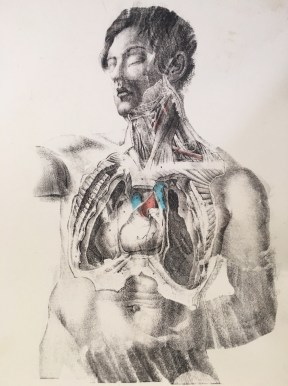
Here’s the note-to-self doodle I made to remind me about this particular bit of symbolism, so I can include it in the essay I’m working on.
Day 8 – I spent a lot of time yesterday thinking about hope. In a book I’m reading called, Grit, author Angela Duckworth follows up her discussion of optimism with a discussion of hope. She says there is a science behind hope. “This growth mindset, the belief that people are designed for change and growth, is what disposes people to be resilient when things don’t go well.”
So much of what happens to us is because of what we believe can happen. Hope.
When I think of hope, I see the word YES in my mind’s eye. The first title I had for this blog was actually: 30 Days to Saying Yes. For me, hope has been fueled by a million minute decisions to say yes instead of no. I see YES as being open to the idea that there is a solution to a problem or another approach to a shitty feeling. It’s hard, but like I said, every single time I catch myself thinking pessimistically, I try to remind myself that I can decide how to approach what I’m experiencing.
Duckworth reports that optimists “are just as likely to encounter bad events as pessimists. Where they diverge is in their explanations: optimists habitually search for temporary and specific causes to their suffering, whereas pessimists assume permanent and pervasive causes are to blame.”
Why would you be hopeful when your problem looks like a room with no door? What if you start by deciding that the room could or could not have a door?
Yesterday, my friend told me about her bummer tarot card reading. She explained how she pulled two so-so cards and then a disappointing third. It was the Two of Swords, which looks like a giant X. She said, it has different meanings, but she reads it as a big ole NO. The question she brought to the cards was about love and if it’s something she’ll encounter on her trip to Scotland at the end of the month. The big X took the wind right out of that sail.
It reminded me of all of the times I’d gone out to a bar or party, hoping to meet someone. As soon as I’d show up and quickly scoped the scene, my heart would drop and I’d regret bothering to put on eyeliner and unwalkable shoes.
Or, how another friend recently put it so aptly, “Just once I’d like to meet my future wife on a cross-country flight.”
About the X card, I said to my friend, “Maybe this is the universe’s way of taking your expectations out of your trip. Then, you can go into it totally open.”
She said, “I’m open to the card being true, but I’m also open to it being not true.”
Later, I sat down to listen to a podcast by one of my favorite spiritual thinker/enlightened individual/practitioner of mindfulness, Tara Brach. Because I’ve struck a synchronicity jackpot lately, the most recent episode was on the subject of, you guessed it, hope! It’s titled, “How hope can heal and free us.”
Seriously, I believe it can.
Brach talks about different types of hope. For example, the ego’s hope, what she calls the shadow side of hope, is when we grasp at things and set our hopes onto one specific outcomes, how this “robs us of the current moment.”
The moment is expansive with possibilities, but it is easy to attach to one that thing we really want and think there is only one path to achieving it. She says, real hope, the kind that expands us, means being ok with it not happening (whatever it might be).
Since normal life is composed of valleys and peaks, or as my sister says, “good shit usually follows bad shit,” and the reverse, hope has to transcend the day to day.
I see this as being about the moment, but not attaching too much the particulars: a romantic fling you didn’t see coming, a trip abroad a few weeks away, a party with so many people you think you might fall in love a hundred times, OR a party where you meet no one and wish you hadn’t put on long-wear lipstick, or a job you didn’t get that you really wanted, or drawing a big X from the cards when you wanted the tarot version of a green light.
(The brilliant artist Sean Higgins graciously allowed me to use this image, Intervention, 2008) for my book cover. It is beautiful and I have loved it since the day I met it.)
Day 7 – It feels so good to do something I was afraid of, moving through it to the other side. I think of the idea that there is no trying, just doing or not doing.
Where does procrastination or inaction come from? Maybe it comes from thinking you can’t or you’ll be judged or feel embarrassed or look stupid while going for it. Maybe you think you weren’t meant for big things or that you’re on some level unlovable or that you’re unworthy of anything more than unhappiness.
I had to meditate on fact that worthiness is not a mutable condition, but a natural expression that comes from and belongs to the timeless wisdom of the universe. What the hell does that mean? It means, my weird and fallible self is the same as a tree. You would never look at a flower and say, that flower is doing a shitty job of being a flower. You would never think that a tree has too many pine needles.
The first poem in my book, Elemental Perceptions: A Panorama, I think, was an effort to tell myself (and my readers) this. Here’s the poem:
This is How a Prism Works
The light enters the glass, bending and refracting it, breaking it up into its constituent colors. The tower separates the color from the light. She said, believe me that you’re a beautiful human being. Think of your insides like a grand spectrum, a forgivable animal, teasing and mortal. The big mirror splintered, then came the din, bearing the cosmos and urging you. You are a body, but try watching your mind think, listen to the maundering; it traces the pacific coast. You can mesmerize all that daunting blue. And when the light breaks, try to appreciate the view.
What else am I saying here besides you are a “forgivable animal”? I’m saying, observe your mind work, watch it think, without (for a moment) doing the thinking itself. I often wonder what the hell spiritual teachers mean when they say, “lead with your heart,” but I think it means let go of trying to control everything and let your controlling mind go. Give the figuring out a break.
One of my favorite reminders from Wayne Dyer: “Stop trying to control and let your life unfold.”
This doesn’t mean you should stop working or doing or reaching for your goals. You should put everything you have into them. But that means being present and putting everything you have in the moment into those actions and that energy.
I haven’t talked much about what happened when I started listening and paying attention to life, but doing so turned out to be the catalyst for my decision to moveabroad. When I stopped trying to control everything, I was overwhelmed with a flood of signs. Actually, a biblical-size deluge.
Here’s one example. I live next-door to a residential care facility. They have a new patient who moved in maybe 6 months ago. She is the bane of my existence. And I feel bad about it.She screams, with the pitch and urgency of someone being murdered, with a rancor so shrill and unbearable that I often want to murder her myself. She is severely disabled, so I feel like an asshole and remind myself to be compassionate. She’s most often heard screaming, “Get outta here” for hours on end. It sometimes starts at 5am, right when I happen to be meditating. It’s always the same. I hear her, I get frustrated and angry, then I tell myself that I’m jerk and that this is my daily lesson in patience.
When the idea that I wanted to move popped in my head, I was kind of frozen for two days, unable to decide if I was going to take this urge seriously. I spent many morning meditations trying to open myself up to the wisdom of the universe and shoot for a little distance from my thinking mind. I was trying to lead with my heart. Then, the lady next door starts screaming. It hits me what she is actually saying, she’s saying “get out of here” and suddenly I feel like she’s talking to me. I start smiling wildly because it’s like a riddle I just figured out. I need to get out of here! I need to move to Germany!
I want to leave you with an excellent quote from Kafka. It might seem contradictory because the first line is “You do not have to leave this room,” but the essence is that the world will offer itself to you if you are still enough to watch and listen to it.
“You do not have to leave the room. Remain standing at your table and listen. Do not even listen, simply wait. Do not even wait. Be quite still and solitary. The world will freely offer itself to you to be unmasked.It has no choice. It will roll in ecstasy at your feet.”-Franz Kafka
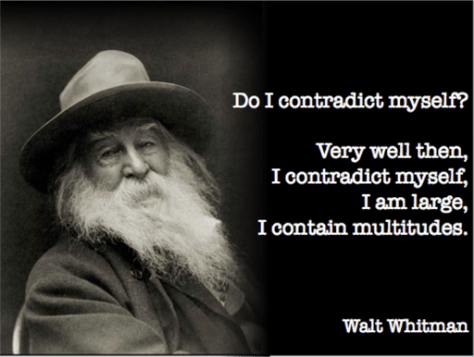
Day 6 – Lovely synchronicity, I opened my email this morning, read a message that linked to an interview that kinda bored me. So I googled the writer being interviewed, Jenny Zhang, and opened a link to one of her essays. The opening line is, “I have lived my whole life swearing there’s no truth more complete than Walt Whitman’s parenthetical line in the poem “Song of Myself”: “I am large, I contain multitudes.”
I’ll read the rest of her essay tomorrow. This perfect lining up of signs is where I’ll stay today.
Day 5 – Even my hair is getting curlier. I just got out of the shower; curliest day yet, which I attribute to my new general breaking the rules attitude.
I had coffee with my friend Karina today. She gave me a present she purchased from a flea market this morning: a Berlin scarf.
This is the first time I’ve seen Karina since she got back from visiting our friend Clare in Berlin who moved to there with her husband and has been living and making art there for 2 years. Karina said she told Clare that I was different than how I was a couple years ago. Clare is a special person. She had a psychic vision about my future that she intimated to me, coincidentally, the morning I decided my marriage was over. It was a big vision and her words gave me fortitude and courage I needed at the time.
After coffee with Karina, I considered how I’d changed myself from an unhappy person into a happy one. Since my divorce, I worried that I’d gone back to exactly who I was before I got married. Re-initiating a life of grasping, suffering, and irreverent faithlessness. But then I got so tired of that. I got tired of responding to the question posed to me at parties, “What have you been up to lately” with the same tired answer, “teaching and working on my book.” I felt stuck and like my life was not one I created. But it was, of course, everything in my life is the result of a decision I made or position I put myself in, minus the normal ups and downs, brightness and dimming of events outside our control.
Karina said I used to be so anxious. I remember myself chain-smoking, drinking like a fish, and frantic to get into a relationship.
I’ve always had so much energy and desire, but I didn’t have confidence or a direction of where to put it. I wrote an epic poem titled Barf, Sexually, which employs the refrain, “what do you do with your love?”
I mean, where does one put her devotion?
Also, where do you put it? I’d like to know—feel free to leave comments 😉
I started thinking about the practical application of my transition into a more mindful, purpose-filled person, the things I actively did to change my outlook.
Namely I started meditating and practicing yoga. That lead to more and more spiritual work, to learning how to be still with myself even through the fear, which I saw underlie my every thought and action. Meditating and practicing yoga brought me from worrying and over-thinking to trusting and staying present, how that makes me feel like the world is full of possibilities, how I am not locked in one small self and one small story, but as Whitman wrote in the poem Song of Myself, “I contain multitudes.”
Early into my daily meditation practice, maybe three months, I had a voice come through to me, it was my own voice and it answered my question, what do you do with your love? It said, “It’s easy: you love.” That was it. “Sophie, you love.” Don’t worry about the how.
Don’t worry about funneling that love into a particular receptacle that is probably too small because anything you can imagine is too small. It is small because it is limited to what you know, while the open contains the truths you do know and the ones you could never have imagined. The unfathomable is the source of hope.
How did this all happen? Certainly not just from getting divorced. But that was the catalyst. When that life-path failed, I swept it out of the way and made room for the unknown. I trudged through the hard work of letting go of some dreams I’d been holding on to since I was a kid.
I did this by believing what was always meant for me, as a living thing worthy as any other living thing is of being what it is, and NOT by thinking that I could trick the universe into giving me what I want.
I gave up control. I gave in to the idea that trying to control my life and happiness completely, excluded all the other possibilities of what a happy life meant. When a friend said to me, “you don’t have to be married to Frank, you can find someone who you really love — I finally understood. My ex-husband is good man, but we were not for each other and that is ok, too.
Letting go of the idea of the life I thought I’d have with him was impossibly hard… for about 3 days. Then my sister told me to make it my choice instead of a thing being done to me. Her advice resonated. My sorrow went from hopeless suffering to a new opportunity. There was no more having to beat a dead horse. It was a relief.
What hurt though, what terrified me, must have been as clear as day because in the first 24 hours of deciding to separate, while I sat on my parents sofa and wept, my dad said to me, “You’ll have children, sweetheart, don’t worry.” Not, “It will be all okay, this is for the best, you’ll find love again,” but the thing I was most afraid of that I wore like a neon orange jumpsuit, “What if I never have a family?”
I would not have a child with my ex. What this looked like, at 34 years old, was “What if there’s not enough time to meet my soulmate, fall in love, and have children all before my healthy childbearing years are up?” The feeling of urgency and desperation that line of reasoning evoked was overwhelming to the point that it choked me, so I embraced the choking fear, and like Chinese finger torture toy you win at the arcade, I figured out that when I just gave in, it released its grip.
Fine, I said, the worst case scenario is just as likely to happen as the best, so there is no reason to worry. What’s worrying going to create except desperation, which we all know a bad look. If anything might influence my future, it is openness; it is rejecting all shoulds, rejecting the idea that there is one way to be happy.
My aunt asked me, about a year after the separation, what I would do about trying to have children. Would I freeze my eggs? Would I look for a sperm donor and do it myself?
I’m not ruling these out, but right now the answer is no.
When I hear about companies paying for women to do this, it feels like the women are being forced out of the present moment and locked into a particular future (also it is fucked up because the other implicit argument in that is that women are not valuable workers unless they push back motherhood). I think I would rather experience not being able to have children than to marry myself to a static, frozen (forgive the pun) future.
This relates to the question I asked myself about how I went from unhappy to happy. Really, all I did was change myself from being pessimistic to optimistic. In Angela Duckworth’s book, Grit, she discusses how people see suffering differently. At the heart suffering is often a feeling of hopelessness, which depends on whether you see suffering as something permanent or something you can change. “Permanent and pervasive explanations for adversity turn minor complications into major catastrophes. They make it seem logical to give up. If, on the other hand, you’re an optimist…these explanations are temporary and specific; their fixability motivates you to start clearing them way as problems.”
One line really got to me, “Optimists are more satisfied with their marriages.” Since my divorce, I thought the main problem was differing views of marriage my ex and I held. I see marriage as infallible, that is, yes, you’ll have problems (maybe lots of them), but that is to be expected and you work on them until they’re fixed. My ex-husband’s view was, life is too short to be miserable. If problems don’t get fixed, you cut your losses and move on. Both are fair arguments, but they are diametrically opposed. We used to quarrel about this all the time. I’d say, “how can you believe our marriage will improve if you don’t really believe problems can be fixed?
I reasoned that my view of marriage was traditional, while he had a modern one—which is true—but it also speaks to our different approaches to suffering. I had a boyfriend say to me once that I’d stay in a bad relationship no matter what, that I didn’t think highly enough of myself to get out of it. That is only a little true. The other part is that I have, at least with love, an attitude toward optimism. I can see how this has both served me and not harmed me at times.
When the plan fell apart and I got divorced, I decided to change some of the perceived areas of lack to perceived abundance, and that engendered more optimism.
I started reminding myself of what I am grateful for starting with the basics, “the sound of my cat’s purring, my soft bed, my sister and brother, my parents, coffee, air-conditioning, etc.”
A new friend recently said to me, as my cat sat beside him purring, “I like the sound they [cats] make.” These little things are everywhere and would compose an entire life if you let them.
Here is another practice of redefining the idea of scarcity or lacking, I listen to Nina Simone’s “Aint Got No, I got Life” over and over. I’ve been doing this for a few months. The song is part of my morning jams that get me stoked on the day.
She says, “Aint got no water, aint got no love”
Aint got no love is the refrain because it is the seemingly the most cruel lacking, “why am i alive any way,” she asks. Then the tune changes:
“I got my arms, I got my hands I got my fingers, got my legs I got my feet, I got my toes I got my liver, got my blood Got life, I got my life”
Also, I’d argue, she has love too because she has the love that she gives out and away!






 30 Days to Berlin